Showing posts with label This Blog. Show all posts

Monday, February 3, 2014

Candlemas (A Poem)

The crowd comes to gather the darkness.
No light to their wicks has yet sprung.
The church doors allow them no entry.
The night is no longer so young.

Face spreads to face a grey pallor.
No mouth to an ear spreads a lie.
Years upon years mark the aged.
In darkness, they ready to die.

Yet hark! Now a spark among tinder!
Yet see! Now a flame doth arise!
Its light, now a color ‘midst pallor!
Its warmth, now a shine in their eyes!

Now candles light, one to another!
The flaming bright, miming the sun!
Face looks to face, sees a brother!
Hope, with the fire, has won!

For Christ has now entered the temple,
And the Holy of Holies revealed!
The veil is now torn for the priesthood,
The crowd opens doors to be healed!

Glory to God in the highest,
For the people have longed to be free!
Glory to Father, Son, Spirit,
One God and one Lord, Trinity.

Ron Dicianni: "Simeon's Moment"

Sunday, October 6, 2013

Miseri Cordis (A Poem)

There is a man who I must be
And yet I do not know his name.
Not yet his body rightly see
Though his cross for mine I claim

Oh the quest through dark night weary
Now my soul must surely claim
For it finds nothing certain clearly
Save uncertainty of name.

And now my wretched heart I know
Holds yet a pain I cannot name
And O this melancholy sow'd
What in reaping will God claim? 

That starkly nameless go I now
Flying fast from flaming claim
Of my soul as is, but how
To crack at the ice and name

The Godhead I so endow
As with life of me, my name
And so freely give up, now,
The free will that I had claimed.

O God, this wretched heart of mine
Is now a mercy that I claim
For though mercy's fogged in time
Heaven's splendor lights my name.

Thursday, October 3, 2013

Evangelism: Gunfights and Boxing

My college happens to have a Baptist Campus Ministry. And while I am not Baptist, it is technically for all denominations of Christians, and since my roommates are Christian as well, and they invited me, I decided to go. 


It was alright for the first hour. There was praise and worship (of which I am not fond), and then there was a sermon on evangelization.
That's when it got interesting.

What the pastor said amounted to this: always look for opportunities to witness to someone, even if you've never met them before. Make friends with them, cultivate their acquaintance in order to share the Gospel with them. Get their story and ask them if they know Jesus. Then, if they do not, launch into the gospel. See if you can't get them 'saved'.
This may be a bad paraphrase of the man, but it is what I took away from the thing.

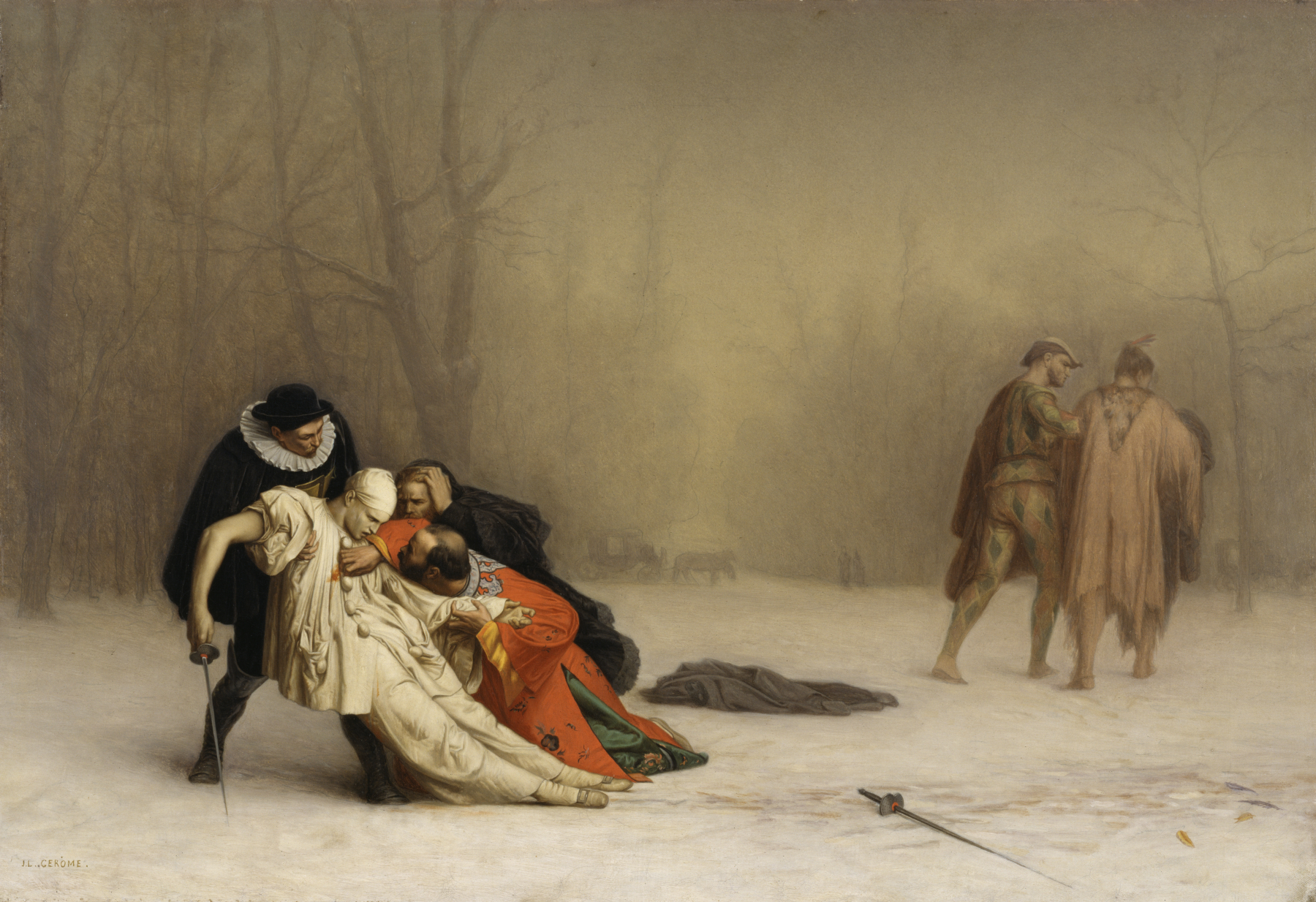
Now, my friends, this does not strike me as the right way of going about the thing. It is making friends, but with an agenda, which is both insincere and self righteous. I would compare it to a duel. Two men meet up somewhere, face off, and fire. It takes three, even two shots, maybe even one for one man to claim victory. In dueling, the two men never really respect each other, they never really become closer to one another. In fact, a duel was often initiated because of a perceived offense to one man or another. 
In this form of evangelization, the Christian initiates conversation because of something he sees is wrong with the other guy. 


Allow me, then, to explain a metaphor of what I think is the right way of going about the thing.

This summer my family went on a fishing trip with a few family friends, and I had to work for the first day, but got to join them for the next days after that because one of our friends had to delay driving down as well. So I got to carpool with him. He is a former boxer from Puerto Rico, and a devout Catholic.
Among the long conversations we had on the way down, I remember this the best: 
He said "Evangelization is like boxing...ya know? You circle the other guy...jab...jab...hook... and you bait him into the knockout."

Now, from what I know about boxing, this makes much more sense than the gunfighter approach. Boxing is characterized by enormous respect, and you really get to know someone by boxing against them. You could take your best friend into the ring, beat him up, and walk out and have a drink with him, or even vice versa- he could beat you up. And it's also the same outcome if the two guys didn't walk into the ring as friends. I mean, take classic boxing movies for example. Rocky's fiercest opponent was Apollo Creed, and they ended up as very good friends because of the respect they earned for each other in the boxing ring.
In boxing, the two guys walk out as friends. In dueling, only one guy walks out.


That is the way it should be: two people spend time becoming friends, circling, if you will. One begins simply referencing the little bits of his faith as it pertains to daily life, like visibly praying before meals, or dressing up for Mass on Sundays. These are the jabs. They lure the other guy in, they inspire and they pique curiosity. Then it is the other man who strikes up the conversation, not the Christian. This initiation is far preferable, too, because often, if the Christian initiates, the other guy will be put off and dismissive of the subject because of the general culture's fears and stigmas about religion. But if the other guy initiates the conversation, he does not enter in with that unwillingness to talk. And I know I would far prefer to talk to someone who actually wanted to have a conversation.
In this form of evangelization, the Christian enters into conversation because of a respect he has for the other man's honor. The Christian may have jabbed first, but he knows that this is simply the way of the game. The game is life, and to jab is natural, else one would not be active in faith. 

Therefore the Christian does not walk into the friendship with a gun and a target, but with a pair of gloves and a willingness to fight. Not picking a fight, but letting a fight pick him. Not as a competition but as a sport. Not death before dishonor, but fighting a good fight.


Sunday, September 1, 2013

The Nature of Modern Heresy...and a little bit of Catholic Memes

By way of introduction, the days of burning heretics at the stake are far behind us. Never was that particular punishment morally right, nor was it condoned by the Catholic Church. Heresy- wrong teaching- has been around as long as there has been orthodoxy- right teaching. The way of fighting heresy is not with a sword held in the hand, but with the sword held in the mouth. The pen, mightier than the sword, will not only defeat the heresy, but also serve to convert the heretic. With that, onward.
Image by: Catholic Memes

 All heresy, that is, all false teaching, is at its heart, a misunderstanding of the truth, perhaps fueled by a single definition gone awry, or a phrase lost in translation. Modern heresies are no different. However, in my experience, modern heresies are all the more prevalent, all the more invasive, all the more insidious because the availability of information today has transformed the heretic from a well-meaning, well-educated, intentional heretic who actually conceives himself as apart from the visible Catholic Church, to an ignorant, perhaps unintentional heretic who thinks that he is well educated, and who may not believe himself to be apart from the visible Catholic Church. In short, what we see today that harms the Catholic Church the most is that- because of ignorance- some of the most obstinate heretics are found in the pews, even regularly so, and are often actively involved in parish life, multiplying heresy by teaching what they have misunderstood.

Fulton Sheen once said that there probably less than 100 people in the USA that hate the Catholic Church for what She really is. The rest of them hate the Church for what they think She is, and there is a huge difference. It is an excellent quote to illustrate that the enemies of the Church are probably not enemies but for their misunderstanding. But quiver at this thought: what if some of the friends of the Church are only friends of the Church because they like what they misunderstand the Church to be? Scary thought indeed.

It rings true, though. How many people only conceive of Jesus as a kind, gentle little lamb of a man who spoke only of love and kindness, and who probably- had he lived today- would have worn a tie-dye shirt and smoked weed? It would certainly seem this way, at least based on some of the songs we sing at Mass. I mean, who actually thinks that "Peace is Flowing Like a River", or "Spirit and Grace" are appropriate hymns to sing at Mass? I'm not going to knock the songs themselves, because they may be good songs, but I do not think that it really reveals the nature of what is happening to the fullest extent.
How many people after that think that it is morally OK to support abortion or contraception and still call yourself a Catholic? Perhaps, "Catholics for Choice"? They are out there. And howabout being Catholic and supporting gay marriage? I actually ran into a group called "Catholics for Marriage Equality" at World Youth Day. That's World Youth Day. I'm surprised at their courage. Moreover, how many people do not go to Confession the minimum of once a year, as the Church has prescribed, because they "have not killed anyone or anything"? How many people conceive of themselves as "good Catholics" despite all of the above?
In short, how many people think that they can take the roses without the war?

Image also courtesy of Catholic Memes


My point is this: all sin demands culpability, including heresy. And while those who sin are held completely accountable for their choice to sin, those who tempt or lead that person into sin must also be held accountable on their own part. I think it was Hans von Balthesar that put it this way: Scandalizing someone (leading them to sin in some way) is like spiritual murder...but allowing yourself to be scandalized is like spiritual suicide. In the same way, the large amount of lukewarm or 'cafeteria' Catholics- the most harmful heretics of our time, or so it seems- are ignorant due to two things: their own choice to be ignorant, and because the rest of us bad Catholics are terrible at teaching them better.

Pope Francis was quite insistent at World Youth Day that we go out and make disciples of all nations, as was the theme. We were to go out and "make a mess". Perhaps we simply need to make an effort- and in making an effort, make a mess- of teaching. It's not all that hard to read the Catechism. It's not all that hard to learn about a Faith that makes complete sense. And while I am not in the particular position to challenge or to make demands, I strongly encourage you, the reader, to look closer at this faith of ours, even if you are not Catholic, but especially if you are.

I really do like Catholic Memes...

Thursday, June 13, 2013

One of the Main Reasons I Don't Post More

Until quite recently – until the latter part of the last century – it was taken for granted that the business of the artist was to delight and instruct his public. There were, of course, different publics; the street-songs and the oratorios were not addressed to the same audience (though I think a good many people liked both). And an artist might lead his public on to appreciate finer things than they wanted at first; but he could do this only by being, from the first, if not merely entertaining, yet entertaining, and if not completely intelligible, yet very largely intelligible. All this has changed. In the highest aesthetic circles one now hears nothing about the artist’s duty to us. It is all about our duty to him. He owes us nothing; we owe him “recognition,” even though he has never paid the slightest attention to our tastes, interests or habits. If we don’t give it to him, our name is mud. In this shop, the customer is always wrong…
But [...] I doubt whether we have a duty to “appreciate” the ambitious. This attitude to art is fatal to good work. Many modern novels, poems, and pictures, which we are brow-beaten into “appreciating” are not good work because they are not work at all. They are mere puddles of spilled sensibility or reflection. When an artist is in the strict sense working, he of course takes into account the existing taste, interests, and capacity of his audience. These, no less than the language, the marble, or the paint, are part of his raw material; to be used, tamed, sublimated, not ignored or nor defied. Haughty indifference to them is not genius nor integrity; it is laziness and incompetence. You have not learned your job. Hence, real honest-to-God work, so far as the arts are concerned, now appears chiefly in low-brow art; in the film, the detective story, the children’s story. These are often sound structures; seasoned wood, accurately dovetailed, the stresses all calculated; skill and labor successfully used to do what is intended. Do not misunderstand. The high-brow productions may, of course, reveal a finer sensibility and profounder thought. But a puddle is not a work, whatever rich wines or oils or medicines have gone into it.
“Great works” (of art) and “good works” (of charity) had better also be Good Work. Let choirs sing well or not at all…”
- C. S. Lewis The World’s Last Night 
One of the main reasons I don't post more is this: that I'm not all that high quality (and I must work to that height with revision and editing (things I don't have time for (or rather, things that I don't often feel like doing))).

Saturday, June 1, 2013

An Example

I was sitting here thinking about how leadership doesn't matter to me. I was sitting here thinking about the imagery of the young man carrying the torch, and about how I don’t care. This supposed journey, this giving-of-commands, this head-over-shoulders ability…it finds only bitter contempt in my heart. I was thinking that I’d write a cop-out about my ‘leadership abilities’, and perjure myself on the stand of life, because I don’t value them. It was then that I realized I do…I must.

In this world, we have a dire need for real leaders. In this world of sinful silence, of hellish hedonism, of casual cynicism, of weakness, we need someone good to imitate. For a leader, I realized, was not made to give commands, he is not better than anyone else, he does not place himself in a position of power. Rather he is placed there by circumstances dire, made better by strife and weakness, and commands only the ceasing of all praise. A leader is the one who cries, if only to himself, “Once more into the breach!”

The question faces me, then. It prompts me, seeking out my weaknesses and revealing them before my eyes. I find that sorrow for my failures wells up in my heart as I am asked “Are you a good leader?” To this, I am forced to answer no. But I try.

Between leading small skiers up a hill, leading humbled youth out of the courtroom, leading the procession down the aisle, leading prayer in a small near-deserted classroom, I find that all I can do is set an example. Leading those children, my skiing technique comes into peak performance, striving, as my body does, to show them how to make it up this hill. I remember youth court, where my speeches given as a youth judge sought to embrace the shaking teen sitting at the defense table, to forgive them, let them go, and encourage them never to do it again. And, while leading prayer is one of the least favorite things that I do as a leader of Christ-Centered Youth, I know I can do it well if I can show them a little bit about how to pray, even if it is just a fragment. I know that I can lead the procession down the aisle at Mass if I can focus on the Crucifix above the Altar.

It might not be a good one, and it might not lead in the exactly right direction, but I can—I must—set an example.

I must promise you that I will use everything I can, all the knowledge in the world, my education, my career, all the strength that I have to set an example for you. If I can do better in the future, if I can encourage you up that hill through the dark, and if I can watch you go happily down the other side, I will know that I have done Okay.


Onward, Christian Soldiers.

Friday, May 10, 2013

A Goodbye to My AP Lit Class (A Memoir)


I once had a dream that I was martyred.
            There are only a few things I remember about that dream: the small details. The first thing that comes to mind is how my own brother took a knife and carved three long gashes into my face. I remember screaming for him to martyr me; I remember yelling at him to give me more. I remember that I wanted welts on my back from whips, and gashes on my face from knives before I died. I wanted to be martyred, that was easy to remember.
            But for the life of me, I cannot remember what his faced looked like, what kind of expression he had, holding that knife. I remember the exact feeling of deadness in my limbs: It’s the same feeling I have when I wake up each day. I remember how weak I was. But for the life of me, I cannot remember what my brother’s expression was while I dreamt of martyrdom. It is this that probably disturbs me the most.

One of the many things that I have discovered while studying this art of expression—what we falsely call an English Class—is a rather simple observation. My favorite word in the English language is the word “rather”. I’ve found that I use it constantly in essays, just instinctually. Allow me to provide an illustration: It’s not that I simply like how it sounds, but rather, it’s what the word does that is important. The word “rather” highlights the ability to make distinctions and to recognize detail. The root of the word means “more readily”, “more willingly”, or “more truly”. This small word not only allows us to parse out those small distinctions, to comb out those small details, but enables and furthers the search for truth.

            When I tell people that Wednesday was my last normal day of school, and Monday is my last day… like… forever, they ask me if I’m excited. “OOoo, are you excited?” they say. My first reaction is to yell out “No!...I’m not excited… Rather, it makes me sad to know that not only is this the end of an era, but I have not made the era into what it could have been”. Of course, to avoid strange looks, I lie through my teeth to admit that yes, it is a little exciting. But what I have realized that it is not for the fun of it that I would do this whole thing again (for some parts were distinctly not-fun). Rather, I feel the obligation to learn, to get that sentence just right, to state the truth just as it is, precisely as it is. And I know I have not. I, like Oskar Schell from Extremely Loud and Incredibly Close, find myself surrounded by detail and simply trying to take, keep, and make sense of those that I can.

            Do you know what’s funny? The word “detail” doesn’t mean what we think it means. We think that it means the little things that are set apart from the whole. The root of the word, however, is this: the combination of the prefix de, which means “entirely” with the suffix taillier, which means “to cut in pieces”. This origin of the word creates a meaning that is more along the lines of metaphorical puzzle pieces. Pieces that we weep over when we’ve finally managed to put together two or three out of the pile.

What I have found is this: that the origin and heart of all our bitter-sweetness—especially about endings, like this one—is that we are, and have been, awash in a sea of detail, and we only have the capacity to take in
a mugful or so
each day with our morning coffee.

And although we may always cry out for more, we always find comfort in those we hold in the silence of our minds, though they be at 2 in the morning, found in the sock drawer—all forgotten, or flitting about a rare hum of a woman whom you thought you knew.
The only thing I can say is seek these out, and join me in the great puzzle as we put the shattered beauty of our lives back together.

Sunday, March 31, 2013

Reach Me a Rose (A Poem)

Reach me a rose
With the formless grace
Of olfactory sunlight

Reach me a rose
Heaped with blooms
Spread like wings
In this valley of ashes

Reach me a rose
Filled with faces dead and
Gone Filled with friends
Gone now and forever

Reach me a rose
Explained by the ferocious
Delicacy and single-mindedness
Of the man I want to be.

~D.L. Piscoya

This Blog as a Celebration


Photo by: www.catholicmemes.com 
Tonight was the celebration of (basically) the Mass of all Masses: the Easter Vigil. As I was serving at Mass, in between the complications of Altar Serving at such a great and long occasion, I realized how much I love Easter Vigil. Even with off-key chanting by deacons, awkward improvisations, crowded Altars full of catechumens, finding thrown away baptismal candles, or my own distracted mind, the Vigil was so amazing that it's joy cannot be compared, in my mind, with any other celebration in the Church.
For me, the Mass every Sunday will remind me of the Vigil, not the other way around. That is its heart: that, every Sunday, we celebrate the day between Christ's sorrowful death and his joyful resurrection in an hour.

Our communion with Christ, during the Mass and during our whole life, is not primarily, I think, one of union with Him on the cross, nor is it union with Him on his resurrection day, but rather it is a communion of waiting, of patient, somber, accompaniment. St. Paul said in one of the (many) readings today that:
"We were indeed buried with him through baptism into death, so that, just as Christ was raised from the dead by the glory of the Father, we too might live in newness of life."
~Romans 6:4
If we were born again into Christ's death through our Baptism, and if we live "in the hope of the Resurrection" after death, then our whole life consists of our adoration of Christ entombed. Christ, through the Eucharist, is entombed in our hearts; just as he is hidden -yet alive- behind stone, so is he hidden -yet alive- behind the forms of bread and wine. 
And this is simply something, celebrated most centrally on Holy Saturday, that we keep coming back to every Sunday of the Year.


This blog of mine, yet new, is, for me, a channel for the graces that God has showered upon me, the philosophical beauties that are sometimes realized, or the poetic thoughts given to me by beauty, or the hardness of war that is begotten by the absence of beauty. It is something, like Holy Saturday, that I keep coming back to.
That, dear reader, is the meaning of celebration. Celebration, in its root form, is originally from the Mass, is from the Latin celebratus meaning "much-frequented; kept solemn" (courtesy of www.etymonline.com).
Through this blog, I intend to elaborate that which I much-frequent, that solemnity which I keep coming back to, which I find that I cannot live without.

Easter is here, my friends, Easter is here.

"At nightfall, weeping enters in, but with the dawn comes rejoicing"
~Psalm 30: 6

Monday, March 25, 2013

An Introduction

I am D. L. Piscoya, I now establish this blog dedicated to War and Roses, to the proposition of conflict with evil, especially that which is within me, and the devotion to the great Beauty of God and His Church here on earth, the Holy Catholic Church. I establish this blog, not as a means of evangelization or apologetics, but as a means of exposition, of an outlet through which I may express the Beauty and intensity of which consists of the better part of my life.
Realizing my own failures both as a person and as a writer, I do not expect that most of that which is written here will be worth reading, but, realizing the Beauty, I cannot remain silent. This is that which lends to life meaning, that through which all literature, indeed, all human experience is explained. And I cannot but show this to you.

I dedicate this Blog to both our Blessed Mother, to whom I have devoted myself, and to St. Therese of the Child Jesus, who has done me many favors and given me many Roses. I pray that they may guide my hand in writing, and allow me to adequately express the Beauty and intensity of Love I have found in Christ's Bride.

This is a blog dedicated to the Church with all her Iron, and to God with all His Beauty.